Today sees the big vote by our British Parliamentarians on introducing a law to allow for assisted dying taking place.
There have been strong views espoused in both directions from the politicians, oftentimes transcedning party lines. Curious coalitions have formed, not least the the one between Diane Abbot and Edward Leigh who penned a joint letter against the proposal. Ministers have been disobeying the Prime Minister’s request for them to keep their opinions to themselves, or at least not campaign on the issue, until the vote.
Feelings run high in our political representatives.
The outcome is, as yet, not all that predictable. Here’s the latest state of play on how MPs are supposedly intending to vote at the time of writing, per the ITV News tracker.

The support amongst the British public for such a proposal does seem somewhat more united though – at least in favour of the general concept of legalising assisted dying.
More In Common did some fairly detailed polling and published a report with the results. They asked the question:
To what extent would you support or oppose a change in law that allowed people, under certain circumstances”, to access medical assistance to end their own lives if they wish to?
Their results showed that 65% of Britons supported such an idea with only 13% opposing. So Britons are five times more likely to support than oppose the idea.
That leaves a substantial 22% who neither supported or opposed, likely a mix of a sense of unsureness – they find later in the survey that only around 40% of us are “very certain” of our views – and perhaps some genuine “it doesn’t bother me either way”.
What’s quite remarkable to me is that – despite being the sort of morally salient, highly impactful, emotionally charge, issue for which the “correct” answer probably isn’t entirely an empirical matter which I’d think was perfect fodder for a culture-war style issue – the topic doesn’t seem to be much of a demographic or even a partisan aligned issue at all.
Support – or at least not opposing – the issue crosses age, gender, education level and geographic region as this chart from the More In Common report shows:

The chart in the report is strangely unlabelled – but darker blue is stronger support, and darker red is stronger opposition. Grey is the “neither support or oppose” option.
It crosses the spectrum of political parties, as measured by who the respondent voted for earlier this year.

More In Common also use a psychographic style model which they apply to respondent. It’s often more predictive of someone’s beliefs than, for example, their demographics. It results in 7 categories, which they described in the below manner.
Progressive Activists: A passionate and vocal group for whom politics is at the core of their identity, and who seek to correct the historic marginalisation of groups based on their race, gender, sexuality, wealth, and other forms of privilege. They are politically engaged, critical, opinionated, frustrated, cosmopolitan, and environmentally conscious.
Civic Pragmatists: A group that cares about others, at home or abroad, and who are turned off by the divisiveness of politics. They are charitable, concerned, exhausted, community-minded, open to compromise, and socially liberal.
Disengaged Battlers: A group that feels that they are just keeping their heads above water, and who blame the system for its unfairness. They are tolerant, insecure, disillusioned, disconnected, overlooked, and socially liberal.
Established Liberals: A group that has done well and means well towards others, but also sees a lot of good in the status quo. They are comfortable, privileged, cosmopolitan,
trusting, confident, and pro-market.
Loyal Nationals: A group that is anxious about the threats facing Britain and facing
themselves. They are proud, patriotic, tribal, protective, threatened, aggrieved, and
frustrated about the gap between the haves and the have-nots.
Disengaged Traditionalists: A group that values a well-ordered society, takes pride in hard work, and wants strong leadership that keeps people in line. They are self-reliant, ordered, patriotic, tough-minded, suspicious, and disconnected.
Backbone Conservatives: A group who are proud of their country, optimistic about
Britain’s future and who follow the news, mostly via traditional media sources. They are
nostalgic, patriotic, proud, secure, confident, and engaged with politics.
There are some differences in support for assisted dying when grouped in this way, but they’re not huge, especially if you focus more on the active opposing side of things. And the two groups with the most positive support for such a law – Loyal Nationals and Progressive Activists – definitely don’t seem like natural bedfellows to me.

The only major breakdown that did show fairly large differences was that by how religious the respondent was. Folk to whom religion is “very important” in their life were more than 4 times as likely to support assisted dying than those for whom religion was entirely unimportant.
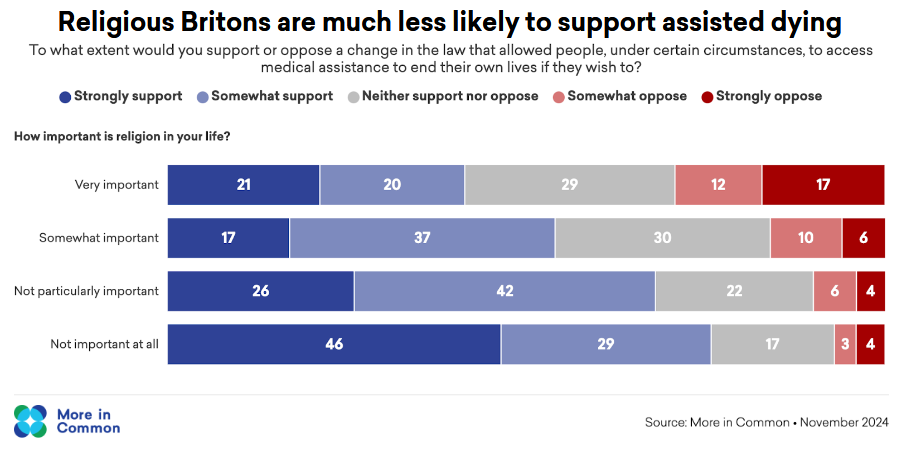
But still, even in the most religious folk, active opposition to the idea was still a minority. The report didn’t break it down by which religion the respondent followed, so it’s of course possible that some are much more against it than others.
One important note is that of course you can be in favour of assisted dying as a concept, but against any particular implementation of it. The same survey found three in five respondents would prioritise making the safeguards on going through with assisted dying pretty strict even at the expense of ending up with substantial barriers to actually accessing such a service.
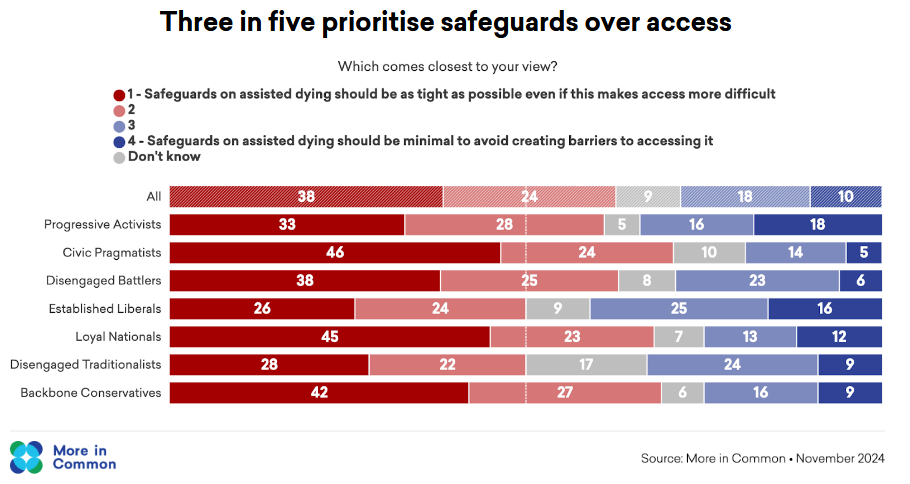
Thus we shouldn’t take the above statistics as representing how Britons would vote on the specific law being debated right now. But rather that there is a potential law enabling assisted dying out there in idea-space that the majority of Britons would be favour of. And that the majority of us – 71% here – do believe it is possible to design a law that would have adequate safeguards.

